
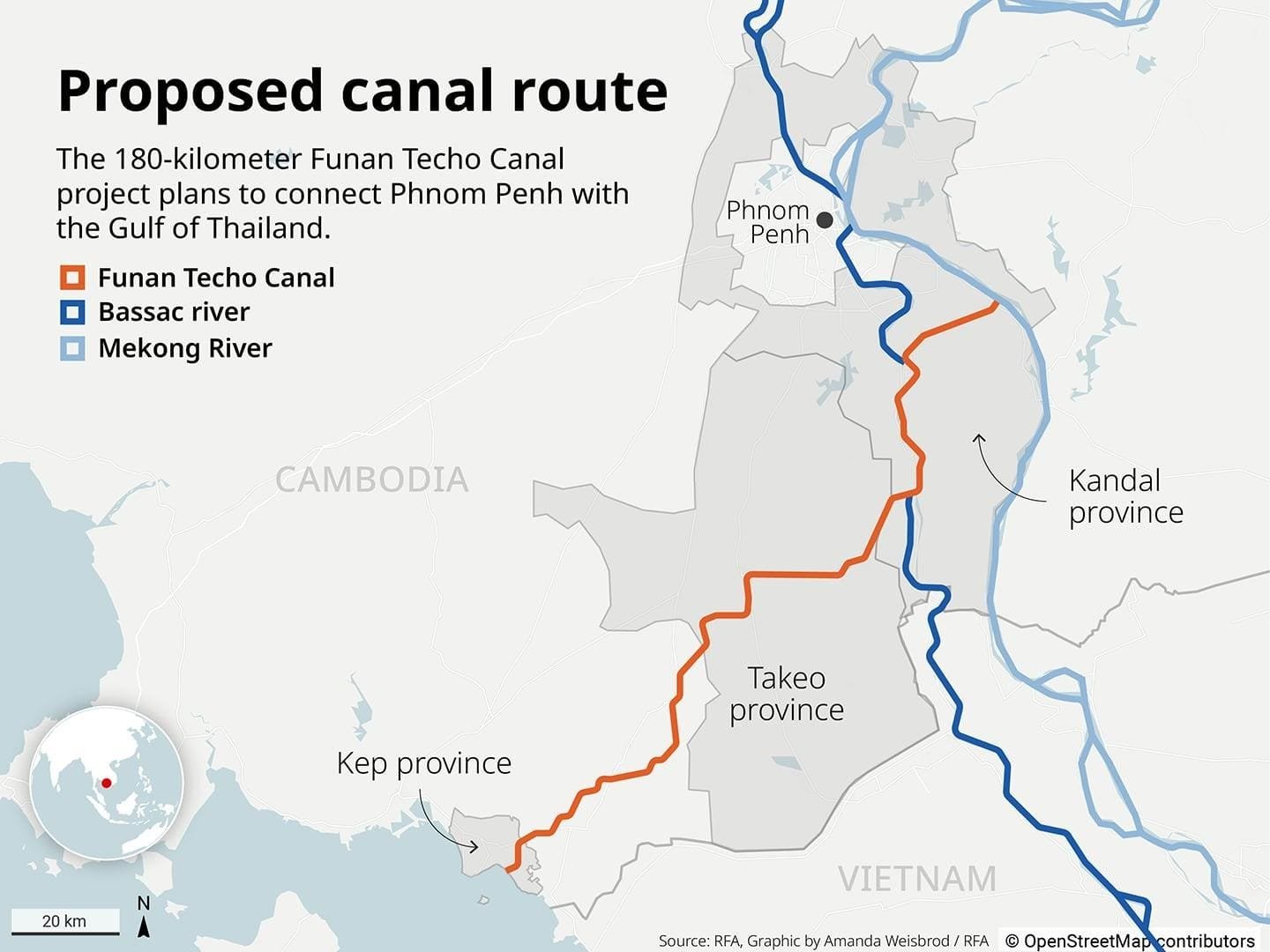
The Funan Techo Canal progress has moved from vision to action. Construction preparations are now advanced, allowing clearer analysis of its economic impact. This 180-kilometer canal will link Phnom Penh directly to the sea at Kep. It bypasses Vietnam entirely. For Cambodian exporters, especially garment producers, this change could be decisive.
Groundbreaking took place on August 5, 2024. By mid-December, land demarcation for phase one reached 55%. Full demarcation is scheduled for July 25, 2025. Excavation will begin in early December 2025 after mine clearance and environmental assessments. The project aims for completion by 2028.
Funan Techo Canal Progress Executive Summary: Lower Costs for Garment Exporters
Cambodia’s garment industry depends heavily on efficient logistics. Today, exports rely on Mekong routes that pass through Vietnam. This adds time, fees, and uncertainty.
The canal will shorten shipping routes between Phnom Penh and the sea. Researchers estimate shipping costs could drop by 20-25%. That equals savings of $170 per 20-foot container and $223 per 40-foot container. Some estimates reach $300 per container.
For garment exporters shipping thousands of containers a year, these savings are substantial. Lower transport costs improve price competitiveness. They also reduce exposure to external port disruptions. This makes Cambodian exports more resilient in global supply chains.
Read Also: Cambodia’s Economic Diversification: Garments to Auto-Parts & Electronics
Economic Returns Strengthen National Goals
The canal’s economic internal rate of return is projected at 30%. This reflects gains across logistics, agriculture, tourism, and manufacturing. The project cost ranges from $1.16 to $1.7 billion, with 49% funded by China.
Officials see the canal as central to Cambodia’s ambition to reach upper-middle-income status by 2030. By integrating Cambodia more directly into ASEAN trade networks, the canal supports long-term export growth and domestic job creation. Estimates suggest up to 1.6 million jobs could be linked to the project over time.
Funan Techo Canal Progress and Trade Autonomy
One of the most powerful impacts of the canal’s progress is autonomy. Today, most Cambodian shipping passes through Vietnamese ports. Once the canal is operational, reliance on those ports could fall to just 10% of shipping volume. That is a 70% reduction.
Prime Minister Hun Manet described this shift as allowing Cambodia to “breathe through our own nose”. The phrase captures the strategic value clearly. Shorter routes improve safety, reduce delays, and keep trade flows under national control. For exporters, this autonomy lowers risk and improves planning certainty.
Strategic Meaning for Regional Logistics
Beyond cost savings, the canal reshapes Cambodia’s role in regional trade. It positions the country as a more independent logistics player within ASEAN. Boundary work already includes 1,920 markers across four provinces, showing the project’s scale and commitment.
By bypassing existing chokepoints, Cambodia gains leverage. Exporters gain speed. Investors gain clarity.
Read Also: Cambodia’s Trade Deal Ambitions Spark New EU Pathways in 2027
The Importance of the Funan Techo Canal Progress
The Funan Techo Canal progress marks a structural shift in how Cambodia trades with the world. Companies seeking to understand logistics impacts, market access, and investment risks can benefit from expert guidance. With 40 years of distinguished experience, Market Research Cambodia by Eurogroup Consulting excels in strategic consulting and market research across Cambodia and the region. Their team provides critical insights for businesses aiming to succeed in a rapidly evolving market landscape.